
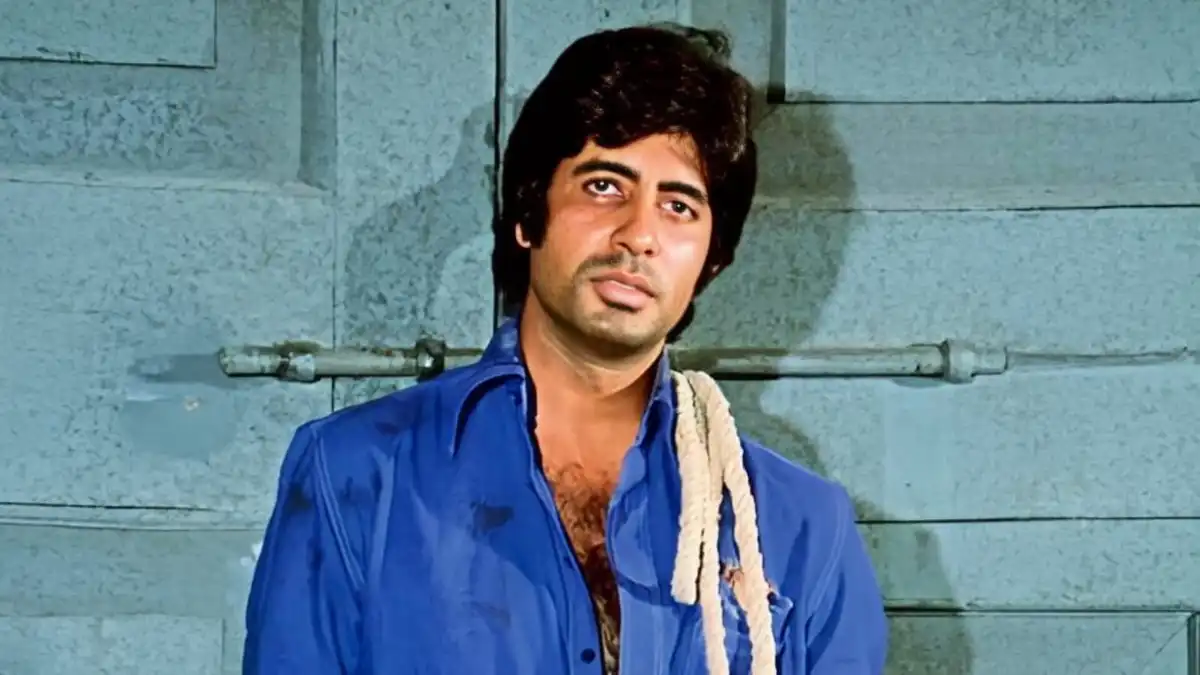
Long before social media turned actors into global celebrities, Amitabh Bachchan had already built an international fan following that few Indian stars could match. During the 1970s and 1980s, Bollywood enjoyed immense popularity across the Middle East and North Africa, but nowhere was the admiration for the actor more surprising than in Egypt.
Indian films had already established a loyal audience in the country. Their emotional storytelling, family values, music, romance and action appealed to Egyptian viewers in a way that Hollywood films often did not. As Bollywood continued to expand its reach, Amitabh Bachchan emerged as its biggest ambassador without ever intending to be one.
His films became regular attractions in Egyptian theatres and later on television. Whether it was the intensity of Deewaar, the heroism of Sholay, the entertainment of Amar Akbar Anthony or the larger-than-life persona he carried in Don and Muqaddar Ka Sikandar, audiences connected deeply with his performances despite the language barrier.
Unlike today’s actors, who rely on social media, digital promotions and streaming platforms to reach international audiences, Amitabh Bachchan’s popularity travelled entirely through cinema. Viewers recommended his films to friends and family, television channels repeatedly aired his classics, and over time he became synonymous with Indian cinema itself.
Many Egyptians who had never visited India and did not understand Hindi still recognised Amitabh Bachchan instantly. For countless moviegoers, Bollywood and Amitabh Bachchan became almost inseparable.
Egypt’s love affair with Amitabh Bachchan
The success of Indian cinema in Egypt did not happen overnight. During the 1970s and 1980s, Egyptian audiences developed a strong appreciation for Bollywood because many of its themes closely resembled those found in their own films.
Stories centred around family, sacrifice, love, honour and justice resonated deeply with audiences. Music was an essential part of storytelling in both industries, and emotional drama often took precedence over visual spectacle.
Amitabh Bachchan’s “Angry Young Man” image proved especially popular. His characters fought corruption, stood up for the powerless and challenged injustice, making him relatable far beyond India’s borders.
Film historians have often pointed out that international audiences didn’t simply admire Amitabh’s action sequences. They admired the emotions behind his performances.
His expressions, body language and commanding screen presence allowed audiences to connect with him even without understanding every word spoken on screen.
That emotional connection became the foundation of his popularity in Egypt.
The visit that turned into one of Bollywood’s most unforgettable overseas moments
By 1991, Amitabh Bachchan’s popularity in Egypt had reached extraordinary levels.
That year, he travelled to Cairo to attend the Cairo International Film Festival, one of the oldest and most respected film festivals in the Middle East and Africa.
Authorities anticipated that the Bollywood superstar would receive a warm welcome.
What happened instead reportedly exceeded every expectation.
Thousands of fans gathered outside Cairo International Airport to welcome the actor. As news of his arrival spread, the crowd continued growing until airport authorities found themselves struggling to maintain order.
According to Amitabh Bachchan’s own recollections, the situation became so overwhelming that officials decided it would be difficult to safely complete normal immigration procedures inside the airport.
He was escorted away under heavy security while the remaining formalities were reportedly completed later at his hotel.
The incident quickly became one of the most talked-about examples of an Indian celebrity’s popularity overseas.
Even decades later, it continues to be remembered whenever discussions arise about Bollywood’s global influence before the internet era.
The story behind the so-called ‘national crisis’
As the years passed, media reports began describing the airport incident as a “national crisis.”
While the phrase sounds dramatic, it refers primarily to the administrative embarrassment caused by the unexpected crowd rather than any controversy involving Amitabh Bachchan himself.
The actor has recalled that Egyptian authorities later reviewed how airport security arrangements had failed to anticipate such an enormous public gathering.
During one of his interviews, Amitabh Bachchan also narrated an incident in which an official allegedly remarked, “How did a third-rater from a third-rate country get this to happen?”
The statement has frequently been quoted over the years because it reflected the disbelief among some officials that an Indian film star could draw crowds comparable to the world’s biggest celebrities.
There has never been any evidence suggesting that Amitabh Bachchan himself was blamed for the chaos. Instead, the episode demonstrated how significantly authorities had underestimated his popularity among ordinary Egyptians.
The film ban story that refuses to disappear
Perhaps no story surrounding Amitabh Bachchan’s Egypt connection has generated more curiosity than the claim that his films were banned because they had become too successful.
The rumour has circulated for decades.
According to the widely repeated version, Egyptian audiences had become so captivated by Amitabh Bachchan’s films that local productions began struggling to compete at the box office. To protect the domestic film industry, authorities allegedly restricted or stopped screening several Indian films, particularly those starring Amitabh Bachchan.
The story has appeared in entertainment magazines, television programmes, newspaper features and countless social media posts.
However, despite its popularity, publicly available evidence supporting the claim remains limited.
Researchers and film historians have not found any official government notification, censorship order or archival document confirming a nationwide ban specifically targeting Amitabh Bachchan’s films.
This does not necessarily mean the story is entirely false.
Many countries have historically regulated imported films to support domestic cinema, and informal restrictions have existed in various markets over the years.
What remains unverified is the specific claim that Egypt officially banned Amitabh Bachchan’s films solely because of their popularity.
For this reason, historians generally treat the story as a widely circulated anecdote rather than a fully established historical fact.
Ironically, the lack of definitive evidence has only made the story more fascinating.
Why the rumour became believable
Even though official confirmation remains elusive, many people found the rumour easy to believe because Amitabh Bachchan’s popularity in Egypt was genuinely extraordinary.
The airport incident itself demonstrated the scale of public admiration.
His films consistently attracted large audiences.
His name became synonymous with Bollywood.
As stories travelled across borders over several decades, facts and folklore gradually merged together.
Entertainment journalism during the pre-internet era also relied heavily on interviews and anecdotes rather than searchable digital archives, making it easier for remarkable stories to grow with each retelling.
Today, the rumour survives largely because it fits the larger narrative of Amitabh Bachchan’s unmatched stardom.
A superstar who represented more than cinema
Amitabh Bachchan’s popularity in Egypt cannot be explained simply by successful films.
His characters represented resilience.
They stood against corruption.
They defended family honour.
They fought powerful enemies despite impossible circumstances.
These themes resonated with audiences across cultures.
For many Egyptians, Amitabh represented justice and determination rather than merely entertainment.
His films also introduced viewers to Indian traditions, music, festivals and family relationships, making Bollywood an important cultural bridge between India and Egypt.
Long before governments spoke about cultural diplomacy and soft power, Indian cinema had already begun strengthening connections between the two countries.
Lesser-known facts about Amitabh Bachchan’s Egypt connection
Many Egyptian fans first discovered Amitabh Bachchan through television broadcasts rather than cinema halls. His classic films continued airing years after their original release, introducing younger generations to his work.
Several people familiar with Egyptian film culture have recalled that Indian movies were often referred to simply as “Amitabh Bachchan films,” even when audiences could not remember the actual title.
His popularity also extended beyond major cities, reaching viewers across different parts of the country.
Unlike many international stars whose fame gradually faded, Amitabh continued receiving admiration decades later whenever he spoke about Egypt or interacted with Egyptian officials.
His affection for the country has always appeared genuine.
Whenever he has spoken about Egypt, he has often remembered the warmth shown by ordinary people rather than focusing solely on official events.
Egypt honoured him decades later
More than thirty years after the famous airport incident, Egypt formally recognised Amitabh Bachchan’s contribution to strengthening cultural ties between the two nations.
In 2024, he received the Honorary Golden License from the Egyptian Tourism Promotion Board.
The honour acknowledged his role in promoting cultural understanding and highlighted the lasting impact Indian cinema had made in Egypt through stars like Amitabh Bachchan.
For many fans, the recognition served as a symbolic full circle.
The same country that had once witnessed unprecedented crowds for the actor officially celebrated his contribution decades later.
Also Read: Ramayana Trailer Leaves Internet Divided: Grand Visuals Win Praise, But Casting and Missing Hanuman Spark Debate
A legacy that continues to fascinate
The story of Amitabh Bachchan’s Egypt connection remains one of the most remarkable examples of Bollywood’s global reach before the digital age.
Some parts of the story are firmly supported by Amitabh Bachchan’s own recollections, including the extraordinary reception at Cairo Airport and the difficulties authorities faced in managing the crowds.
Other aspects, particularly the long-standing claim that his films were officially banned because they had become too popular, remain part of Bollywood folklore due to the absence of conclusive historical documentation.
Yet even without the rumours, the facts themselves are extraordinary.
An Indian actor becoming one of the most recognised foreign film stars in Egypt, drawing thousands of admirers to an airport, and continuing to be celebrated decades later is a rare achievement in world cinema.
In an era when international fame depended solely on theatrical releases, television broadcasts and the power of storytelling, Amitabh Bachchan managed to build an overseas legacy that still captures public imagination today. His Egypt story remains a reminder that true stardom is measured not only by box office success at home but also by the ability to connect with audiences across cultures, languages and generations.

